+86-158-9507-5134
[email protected]
 EN

Bar And Tube Automatic Storage Systems are a crucial component of modern metal processing industries, enabling intelligent, automated, and flexible production. Primarily designed for round steel, square steel, flat steel, aluminum profiles, stainless steel bars, seamless steel pipes, welded steel pipes, square tubes, rectangular tubes, and various metal profiles, these systems integrate automated storage, intelligent management, automated inbound and outbound operations, material sorting, automated conveying, and production line integration.
Traditional bar and tube warehousing typically relies on manual handling, overhead crane lifting, forklift transport, and manual registration. This method not only occupies significant factory space but also suffers from difficulties in material locating, low handling efficiency, inaccurate inventory management, and high safety risks.
Automated warehousing systems, through automated racking, intelligent stacking equipment, automated conveying mechanisms, a Warehouse Management System (WMS), and a Warehouse Control System (WCS), achieve full automation from raw material warehousing to production line feeding.
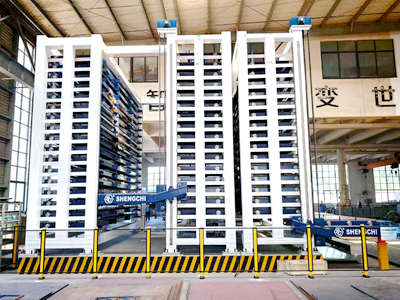
An automated storage system for bars and tubes is a smart logistics system specifically designed for the storage and handling of long-length metal materials.
Unlike automated storage systems for ordinary sheet metal, bars and tubes have the following characteristics:
- Longer Length: Common lengths are 3 meters, 6 meters, 9 meters, 12 meters, and even longer.
- Diverse Shapes: Including round, square, rectangular, and irregular cross-sections.
- Heavier Weight: Some steel bundles can weigh several tons.
- Prone to Rolling: Round steel and tubes require reliable anti-roll structures during storage.
- Complex Specifications: Varying diameters, wall thicknesses, lengths, materials, and cross-sectional dimensions.
- High Material Management Requirements: Differentiation is required based on material, specifications, batch, and order.
Therefore, automated storage systems for bars and tubes cannot simply use ordinary shelving; they require specialized storage units and automated handling mechanisms designed for long materials.
- Automated Storage Racks: Store bars, pipes, and profiles.
- Storage Silos/Frames: Categorize and store materials of different specifications.
- Automatic Stacker Cranes: Enable automated storage and retrieval of goods.
- Transverse Conveyors: Transfer materials between different storage locations.
- Automatic Loading and Unloading Mechanisms: Deliver materials to processing equipment.
- Inbound/Outbound Conveyor Lines: Enable automated material entry and exit from the warehouse.
- WMS Management System: Manages inventory, batches, storage locations, and orders.
- WCS Control System: Coordinates the operation of various mechanical equipment.
- Safety Protection System: Prevents accidental entry and equipment collisions.
The entire system typically combines automated three-dimensional warehousing with intelligent logistics conveying.
Operators or upstream logistics equipment place bars and tubes at designated inbound workstations.
The system identifies material information via barcodes, QR codes, or RFID, including:
- Material Name
- Material Specifications
- Length and Diameter
- Material Weight
- Material Type
- Supplier and Batch
- Quantity Inbound
The system automatically generates inventory records and allocates optimal storage locations based on space utilization.
Materials enter the warehousing system via conveyor mechanisms.
Automatic stacker cranes or dedicated long material handling equipment, according to WMS instructions, grab the corresponding storage frames or material units and deliver them to the designated storage locations.
During storage, the system considers:
Whether the material length matches the storage location dimensions.
Whether the load-bearing capacity of a single storage location meets requirements.
Whether different specifications of materials need to be stored in separate areas.
Whether the outbound frequency and storage location are reasonable.
When the production department needs materials of a certain specification, operators input the production order or material number into the system.
The WMS automatically queries the inventory, confirming the material's location, quantity, batch, and availability status. The system then sends an outbound task to the WCS.
Automatic stacker cranes travel to the designated storage location according to the task, retrieve the target material or storage unit, and deliver it to the outbound workstation.
For materials requiring further sorting, automated sorting mechanisms, length measuring devices, and conveyor lines can be configured.
Outbound materials can be further transported to:
- CNC sawing machines
- Laser pipe cutting machines
- Plasma cutting equipment
- Pipe processing centers
- Profile processing centers
- Automatic drilling equipment
- Automatic welding production lines
Thus forming an integrated production model of raw material warehousing, intelligent logistics, and automated processing.
Based on warehousing structure, material specifications, and degree of automation, they can be divided into the following types.
Tower storage systems utilize a vertical, multi-layered storage structure, achieving automated material storage and retrieval through lifting mechanisms and dedicated material racks.
Key Features:
- Effectively utilizes vertical space in the factory.
- Relatively small footprint.
- Suitable for small to medium batches of materials with multiple specifications.
- Automatic inbound and outbound operations are possible.
- Easy to connect with sawing and laser cutting equipment.
- Suitable for bars, tubes, and profiles within the equipment's design range in length and weight.
Utilizes a multi-row, multi-layer rack structure, achieving material storage and retrieval through stacker cranes, shuttle cars, or dedicated handling equipment.
Key Features:
- Large storage capacity.
- Flexible location planning.
- Suitable for large-scale metal processing enterprises.
- Capable of managing multiple specifications and large batches of materials.
- Easily expandable with automated conveyor systems.
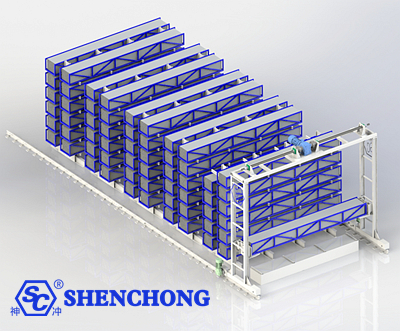
Equipped with multi-layer drawers or movable storage units, each drawer stores one or more planned types of materials.
Key Features:
- Clear material classification.
- Definite material retrieval locations.
- Suitable for multi-variety, small-batch production.
- Reduced manual material searching time.
- Automatic lifting and extraction mechanisms can be configured according to requirements.
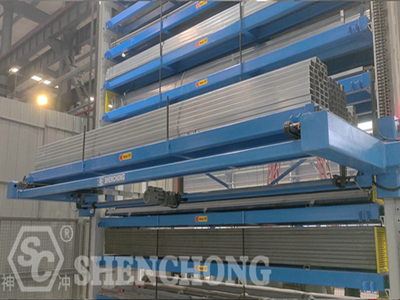
This system uses cantilever racks to store long bars and tubes, which are then accessed via automated guided vehicles (AGVs).
Key Features:
- Suitable for extra-long profiles.
- Easy to access long materials.
- Open rack structure with good adaptability to different sizes.
- Can be configured with automated sorting and conveying equipment.
Types | Storage capacity | Space utilization rate | Applicable Scenarios |
Tower system | Medium | High | Small and medium-sized material warehouses |
Automatic racking system | High | High | Large material warehouses |
Drawer system | Medium | Relatively high | Multiple varieties, small batches |
Cantilever system | Hig | Medium | Extra-long bars and tubes |
The above is a qualitative comparison of structural types; actual capabilities depend on size, weight, number of storage locations, and equipment configuration.
The design challenge of bar and tube automatic storage systems lies not only in increasing the number of shelves, but also in solving the problems of load-bearing, positioning, stable storage, and automated handling of long materials.
Long materials are typically stored using dedicated storage frames, storage pallets, or load-bearing racks.
Design considerations include:
Multi-point support: Preventing long bars and tubes from bending under their own weight.
Anti-rolling structure: Round steel and round tubes require limit blocks or dedicated positioning structures.
Zoned storage: Materials of different diameters, lengths, and materials should be rationally classified.
Load-bearing capacity: Designing structural strength based on the maximum weight of each storage frame.
Material protection: Stainless steel, aluminum, and precision tubes need to be protected from surface scratches and collisions.
Two storage methods can be used in actual projects:
Storage methods | Features | Applicable Materials |
Tray-based storage | Materials are centrally stored and transported as a whole | Bundled bars and pipes |
Trayless storage | Direct storage and retrieval in designated storage locations | Materials with stable shape and uniform specifications |
Some long material systems also support customized pallets based on the shape of the customer's materials. The load-bearing capacity and applicable range vary significantly depending on the pallet structure.
Automated handling mechanisms are the core of the entire system.
The main types are as follows:
- Operates along fixed tracks.
- Automatically locates the goods.
- Achieves horizontal movement and vertical lifting.
- Suitable for multi-level, multi-position automated warehouses.
- Handles materials across racking areas.
- Suitable for long, heavy materials.
- The travel range can be customized according to the warehouse layout.
- Suitable for storing large bars and pipes.
- Extracts the target material frame from the storage location.
- Delivers it to the operating station via a lifting mechanism.
- Suitable for compact vertical storage systems.
When selecting a model, it is crucial to consider the equipment's maximum load, handling length, positioning accuracy, operating speed, pick-and-place method, and continuous operation capability.
The value of automated warehousing lies not only in storage but also in the accurate delivery of raw materials to processing equipment.
Typical configurations include:
- Automatic lifting device
- Automatic lateral conveyor mechanism
- Pipe sorting device
- Bar positioning mechanism
- Automatic length measuring device
- Automatic feeding roller conveyor
- Processing equipment interface
For example, on a laser tube cutting production line, the warehousing system can automatically retrieve tubes of specified specifications based on production orders and deliver them to the laser tube cutting machine via conveying and loading devices.
Note:
Automated warehousing is not equivalent to automatic tube splitting, automatic length setting, and automatic feeding. These functions require separate configuration of corresponding mechanisms and control programs.
To ensure accurate inventory data, it is recommended to use barcode, QR code, or RFID identification technology.
The system can record in real time:
- Material name and specifications.
- Material batch and supplier.
- Inbound time.
- Current storage location.
- Remaining inventory quantity.
- Quantity already issued.
- Surplus and returned material information.
Batch tracking is especially important for high-value stainless steel, alloy steel, and specialty materials.
A complete intelligent warehousing system must achieve coordination between mechanical equipment, control systems, and production management software.
A four-layer control architecture is typically used:
System Hierarchy | Main Functions |
ERP Enterprise Management System | Production planning, procurement, sales, and orders |
WMS Warehouse Management System | Inventory, location, batch, and inbound/outbound management |
WCS Equipment Scheduling System | Automatic allocation and coordination of material handling tasks |
PLC Equipment Control System | Control of motors, sensors, lifting and conveying mechanisms |
WMS is the management center of the entire warehouse.
Main Functions:
- Automatic inbound registration
- Intelligent location allocation
- Real-time inventory query
- Batch management
- FIFO (First-In, First-Out) management
- Production order material requisition
- Inventory alerts
- Surplus material management
WCS is responsible for translating warehouse management tasks into actual equipment actions.
For example: The production department needs a batch of 50mm diameter stainless steel bars. After the WMS confirms the inventory, it sends an outbound task to the WCS.
The WCS schedules the stacker crane, conveyor, and lifting mechanism to complete the actions based on the equipment status.
PLC is responsible for the actual execution of:
- Motor start/stop
- Servo positioning
- Lifting control
- Conveyor control
- Sensor detection
- Limit protection
- Fault alarm
- Emergency stop interlock
A stable data communication and fault feedback mechanism needs to be established between the three systems. WMS is responsible for business and inventory, WCS is responsible for equipment scheduling, and PLC is responsible for on-site execution.
Core Advantages | Specific Features | Business Benefits |
Saving storage space | Multi-layer automated storage | Reduced floor space |
Improving storage and retrieval efficiency | Automatic positioning and handling | Shorter material preparation time |
Reducing labor costs | Reduced manual handling and searching | Reduce repetitive work |
Enhancing security | Reduced personnel access to heavy material handling areas | Reduce safety risks |
Precise inventory management | Automatic recording of location and quantity | Reduce inventory errors |
Protecting material quality | Dedicated support and limit switches | Reduce collisions and scratches |
Boosting production efficiency | Automatic connection to processing equipment | Reduce waiting time for materials |
Enabling batch tracking | Recording of material and supply batches | Facilitate quality traceability |
Improving space utilization | Reduced forklift aisles and manual operating space | Optimize factory layout |
Supporting smart manufacturing | Integration with ERP and MES | Digitalize production logistics |
Traditional warehouses typically use floor stacking or ordinary cantilever racks.
Long materials occupy a large amount of space, and aisles need to be reserved between materials for handling.
Automated warehousing, through multi-level storage locations and specialized handling equipment, can fully utilize factory height, reducing the area of materials laid flat.
Bars and tubes are often heavy, long, and prone to rolling.
Manual handling using forklifts, cranes, and overhead cranes requires multiple people and carries risks of collisions, slippage, and crushing.
Automated systems can reduce the number of times personnel are directly involved in handling heavy materials.
Traditional warehouses are prone to problems such as unclear material placement, mixed specifications, and delayed inventory records.
Automated systems can achieve location binding and inbound/outbound recording, helping companies establish a more accurate inventory management mechanism.
When the warehousing system is connected to laser tube cutting machines, CNC sawing machines, and profile processing centers, materials can be scheduled according to production tasks. This helps reduce the time production equipment spends waiting for materials, improving the efficiency of production plan execution.
- Steel Processing Industry: Storage of round steel, square steel, flat steel, and alloy steel.
- Stainless Steel Industry: Management of stainless steel tubes, bars, and precision profiles.
- Aluminum Profile Industry: Storage of aluminum alloy profiles and long-length extruded materials.
- Automotive Manufacturing Industry: Management of automotive structural tubing and metal parts raw materials.
- Construction Machinery Industry: Hydraulic tubing, structural steel, and mechanical bars.
- Steel Structure Industry: Management of H-beams, square tubes, rectangular tubes, and long profiles.
These applications share common characteristics: a wide variety of raw material specifications, long lengths, frequent handling, and the need to establish stable logistical connections with subsequent processing steps.
This is the most crucial part for enterprises when purchasing automated warehousing systems for bars and tubes.
Different materials have different lengths, diameters, weights, and storage quantities, resulting in significant differences in system structure.
Parameter Items | Design Considerations |
Material Type | Round steel, square steel, steel pipe, aluminum profiles, etc. |
Maximum Storage Length | 3m, 6m, 9m, 12m or custom sizes |
Minimum Material Length | Determine the minimum storage unit and support spacing |
Maximum Unit Load | Determine based on the maximum weight of a single storage box |
Material Diameter | Determine the width of the storage box and the limiting structure |
Material Cross-Section | Round, square, rectangular and irregular cross-sections |
Number of Storage Locations | Determine based on inventory SKUs and inventory levels |
Warehouse Height | Determine the number of shelf layers and equipment lifting range |
Inbound/Outbound Efficiency | Determine based on the number of storage and retrieval tasks per hour |
Control System | PLC, WCS, WMS, ERP interfaces |
Degree of Automation | Semi-automatic, stand-alone automatic, fully automatic production line |
Safety Configuration | Photoelectric protection, fencing, door locks, emergency stop, etc. |
Material Types | Design Highlights | Recommended System Options |
3-meter short bars | Multi-specification classification | Drawer-type or Tower-type |
6-meter steel pipes | Long material support, automatic material handling | Tower-type or Automated Storage and Retrieval System |
9-meter long bars | Long-distance handling stability | Gantry-type or Dedicated Automated Storage and Retrieval System |
12-meter steel pipes | Extra-long material support and synchronous handling | Customized Long Material Storage System |
Heavy-duty round bars | High load capacity, anti-rollover | Heavy-duty Pallet Racking |
Aluminum profiles | Surface protection, deformation prevention | Dedicated Flexible Pallet System |
The above outlines the proposed solutions, not a unified equipment load-bearing standard. Ultimately, structural calculations are needed based on material weight, length, cross-section, number of storage locations, and factory conditions.
It's not enough to simply focus on the total warehouse capacity; the rated load-bearing capacity of each storage unit, handling mechanism, and racking must also be confirmed.
A nominal storage capacity of 6 meters of material does not guarantee that all 6 meters can be automatically handled. The effective length of the material rack, support positions, and equipment operating space must also be verified.
It's necessary to clarify whether the supplier's stated efficiency refers to a single retrieval or storage operation, or a complete inbound and outbound process.
It's crucial to determine whether the system can connect to laser tube cutting machines, CNC sawing machines, automated feeding equipment, and MES (Manufacturing Execution System).
Can the existing system be expanded to accommodate future additions of storage locations, processing equipment, or automated conveyor lines?
This is one of the most valuable application directions for automated warehousing systems.
Simply building a smart warehouse only improves the warehousing process. Connecting it to processing equipment creates a complete intelligent production and logistics system.
Workflow:
Raw materials enter the smart warehouse.
The system retrieves the specified specifications of bar stock based on the production order.
Automatically conveys the stock to the loading station of the sawing equipment.
The CNC sawing machine automatically completes the cut to length.
Finished products enter the unloading area.
Remaining materials are re-registered and stored.
Applicable Scope:
Round steel, square steel, aluminum bars, copper bars, and various metal profiles.
Workflow:
The system receives pipe processing orders.
Automatically identifies material specifications and inventory.
Retrieves the corresponding pipe stock.
Automatically sorts and loads the material.
The laser pipe cutting machine performs the cutting.
Finished products are automatically unloaded.
Remaining pipe stock is re-measured, registered, and managed.
Scope of Application:
Round tubes, square tubes, rectangular tubes, and irregularly shaped tubes.
By connecting an intelligent warehousing system with a profile processing center, automated feeding, positioning, drilling, milling, cutting, and blanking of profiles are achieved.
Suitable for door and window, building profiles, rail transportation, and industrial structural component manufacturing.
We recommend conducting a procurement evaluation according to the following six steps:
Determine whether the primary storage will be round steel, square steel, steel pipes, aluminum profiles, or a mixture of various long materials.
Organize the material length, diameter, cross-sectional dimensions, single-piece weight, and maximum bundle weight.
Determine the number of storage locations based on the number of SKUs, inventory turnover rate, and future production capacity.
Measure the length, width, height, ground bearing capacity, fire escape routes, and equipment access space of the factory.
Based on budget and production needs, select a semi-automatic, fully automatic, or production line integration solution.
Focus on evaluating their capabilities in mechanical design, software control, system integration, installation and commissioning, and after-sales service.
When purchasing suppliers, it is recommended to compare the following:
Evaluation Items | Recommended assessment criteria |
Equipment Design | Experience in long-material storage projects |
Structural Manufacturing | Rack strength, rack quality, load-bearing capacity |
Automation Technology | Positioning, handling, conveying, and control capabilities |
Software Capabilities | Integration with WMS, WCS, ERP, and MES |
Safety Design | Fall prevention, roll prevention, and personnel isolation |
Project Experience | Successful case studies in similar industries |
After-Sales Service | Spare parts supply, remote diagnostics, and on-site service |
It is specifically recommended that suppliers conduct simulation tests using actual customer materials to verify whether the heaviest, longest, shortest, and most difficult-to-handle materials can be stored and retrieved normally.
The future of automated warehousing for bars and tubes will gradually evolve from single storage devices to intelligent production logistics systems.
There are five main trends:
Warehouses are no longer independent raw material storage areas, but rather intelligent material supply centers for production lines.
Optimizing material storage locations, outbound sequences, and replenishment plans through historical orders, production plans, and inventory data.
Adjustable clamping, lifting, and conveying mechanisms are used for materials of different lengths, weights, and shapes.
Real-time display of storage locations, equipment status, inventory, and logistics tasks through 3D warehouse models.
Integrating automated warehousing, AGVs, robots, laser tube cutting machines, CNC sawing machines, and automated testing equipment to gradually automate the entire process from raw material warehousing to finished product outbound delivery.
Compared to traditional ground stacking, rack storage, and manual forklift handling, automated warehousing systems utilize automated racking, intelligent control systems, automatic lifting devices, conveyor mechanisms, and automated loading and unloading equipment to achieve centralized storage, automatic retrieval, accurate inbound and outbound operations, and efficient distribution of bars, round steel, square steel, profiles, and metal pipes.
Its core value lies not only in saving warehouse space, but more importantly, in connecting raw material management, production distribution, and logistics handling to form a complete intelligent material management system.
From a practical business perspective, the most important aspects of selecting a system are clarifying three key questions:
- What to store? Material type, length, diameter, wall thickness, weight, and packaging method.
- How much to store? Number of SKUs in stock, storage space requirements, and future expansion plans.
- How to use it? Hourly inbound/outbound frequency, type of production equipment, and whether automated loading/unloading is required.
The core value of bar and tube automatic storage system lies in upgrading the traditional material storage and manual handling model to an intelligent, digital, and automated production logistics model.
For modern metal processing enterprises, I believe the most important focus is not simply on increasing the number of storage locations, but on three core issues:
- Storage Capacity: Can materials of different lengths, weights, and specifications be stored safely and densely?
- Logistics Efficiency: Can automated warehousing, outbound delivery, and sorting be completed quickly and accurately?
- Production Integration: Can it form an automated production chain with laser tube cutting machines, CNC sawing machines, and profile processing centers?
The ultimate goal is not simply to build an automated warehouse, but to establish a complete intelligent logistics system encompassing raw material warehousing, intelligent storage, automated distribution, and production processing. Only by combining these three aspects can the true value of intelligent warehousing be realized.